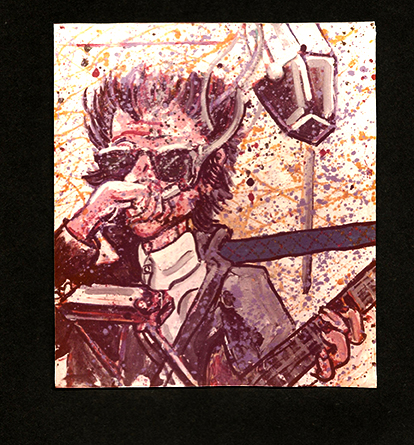
Private Collection, NYC
In a world often captivated by artistic trends, some artists quietly forge their own paths, their influence and dedication making a lasting, if often unheralded, impact. Dan Freeman is one such figure, an artist whose career is a compelling study in unwavering commitment to his own narrative vision. While many of his peers chased fleeting movements, Freeman remained steadfast, a quality that defines his journey.
His artistic odyssey began with the academic discipline of still-life painting under the guidance of John Moore. However, it was his transition to figurative work that truly ignited his unique perspective. In graduate school, mentored by masters like A. Robert Birmelin, Louis Finkelstein, and Lennart Anderson, Freeman cultivated an audacious principle: “inventing in the face of reality.” This concept, which posits that the artist’s imaginative construction holds equal weight to objective observation, became the philosophical bedrock of his work. This conviction was further solidified at the Skowhegan School of Painting & Sculpture—where he attended on a full scholarship for fresco painting—leading him to the profound realization that invented figurative painting is, in its essence, a form of “true” abstraction. His time there was also marked by spirited interactions with the legendary Paul Resika, whose defiance of artistic trends left an indelible mark on Freeman’s aesthetic.
After his studies, Freeman immersed himself in the pulsating heart of the art world, New York City, where he served as a studio assistant to giants like Alice Neel, Larry Rivers, and Karl Schrag. His brief association with Mimi Gross and Red Grooms’ monumental installation, Ruckus Manhattan, placed him squarely in a dynamic, collaborative art scene. Freeman’s dedication to narrative blossomed in the late 1970s. With early support from a National Endowment for the Arts (NEA) grant, he embarked on a groundbreaking multimedia project: a series of 42 paintings and a film inspired by Bob Dylan’s “The Ballad of Frankie Lee and Judas Priest.” This was an early testament to his commitment to interdisciplinary storytelling. His role as a pivotal, behind-the-scenes force became even clearer in 1979 when he crossed paths with the nascent street artist Keith Haring. Freeman’s voluminous, story-filled sketchbooks so impressed Haring that, by Freeman’s own account, Haring was “quite impressed” with their creative force and narrative density.
In 1980, Freeman cemented his legacy as a cultural connector by founding DUMB (Down Under Manhattan Bridge), a vital magazine that served as a crucial platform for both established and emerging artists and poets. The inaugural issue alone featured luminaries like Alex Katz and Arlene Slavin, while subsequent collaborations with poets such as Lou Reed underscored Freeman’s role in bridging artistic disciplines. During this period, Freeman’s personal style fully coalesced, as he channeled his energy into a “Neo-Expressionist”/Narrative Figure painting style that boldly embraced the structures of comic books. The resulting works, often humorous and at times searingly confrontational, demonstrated a fearless commitment to storytelling. This narrative impulse, propelled by his mastery of contour drawing and vibrant color, remains the central thread of his entire body of work.
Throughout the 1980s, Freeman remained a dedicated presence, curating exhibitions for DUMB and holding solo exhibitions at Semaphore Gallery. His representation by M13, a gallery directed by Howard Scott, one of the few Black gallerists in New York at the time, highlights Freeman’s place within the city’s diverse art community. A second NEA grant in 1989 further validated his unique vision. While he spent the 1990s in the world of advertising and computer graphics to make a living, studying with design luminary Milton Glaser and animator John Canemaker, Freeman never abandoned his personal projects. His decades-long labor of love with poet James Feast on the poetry video “Con Lady and the Unknown Gangster” was a testament to his enduring creative passion. This work paved the way for his later series of multi-panel narrative murals, “American Dream,” a suite of paintings influenced by graphic novels, James Rosenquist, and Roy Lichtenstein, solidifying his role as a master storyteller.
More recently, Freeman has continued to innovate, incorporating the iPad into his artistic process, proving that his artistic curiosity is as boundless as ever. By the 2020s, he had turned his attention to exquisite flower paintings and portraits of poets, capturing the essence of figures like Eileen Myles and Vincent Katz. A new, dramatic collaboration with poet Jeffrey Cyphers Wright has reignited his fervor for invented figure painting, a return to his roots that underscores the cyclic, ever-evolving nature of his career. This project has spurred a return to the voluminous, production-oriented style of his youth—a testament to the enduring power of his artistic vision, and a reminder that some of the most profound contributions to art history are made by those who are content to work outside the glare of the spotlight.
Summer 2025
danyo001@yahoo.com
mgmt@danfreeman.co